Individual project · Giovanna Calabrese Villanueva
53,940original records
$872.09expanded-model test MAE
24.5%lower test MAE
The question
Is weight enough to price a diamond?
For a hypothetical new U.S. jewelry company, I investigated the relationship between carat weight and price — then tested whether adding cut, color, and clarity produces better estimates. The objective is a more structured pricing discussion, not an automated selling-price rule.
The data
53,940 records of price and quality.
The Seaborn diamonds dataset includes carat, cut, color, clarity, depth, table, price, and physical dimensions. Prices range from $326 to $18,823; weights range from 0.20 to 5.01 carats. No missing values were identified.
For the held-out comparison, I removed duplicate combinations of price, carat, cut, color, and clarity before splitting. The resulting 39,756 unique combinations produced 31,804 training records and 7,952 test records. These are distinct from the full-data descriptive analysis.
The approach
Start with weight. Test the added information.
Explore distributions and relationships; calculate Pearson correlation.
Fit a full-data simple linear regression and inspect residuals. Examine model significance with OLS and ANOVA.
On the deduplicated 80/20 split (random_state=42), fit a carat-only model and an OLS model adding categorical cut, color, and clarity.
Evaluate both on the identical test records using MAE and RMSE in USD.
The evidence
A strong association still leaves pricing errors.
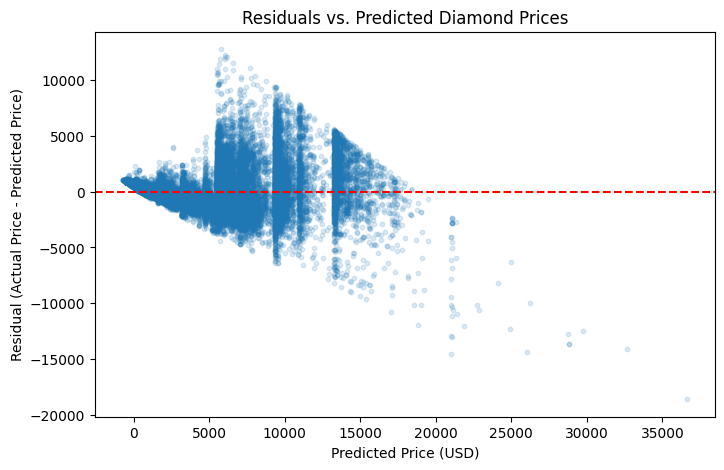
Carat and price have a Pearson correlation of 0.9216. The full-data line is price ≈ −2,256.36 + 7,756.43 × carat, with R² ≈ 0.849. This descriptive fit is separate from the held-out comparison below.
Original notebook chart · Residuals from the full-data carat-only model show uneven error and overestimation at the highest fitted values.
Held-out model
Test MAE (USD)
Test RMSE (USD)
Carat only
$1,154.76
$1,702.35
Carat + cut + color + clarity
$872.09
$1,242.03
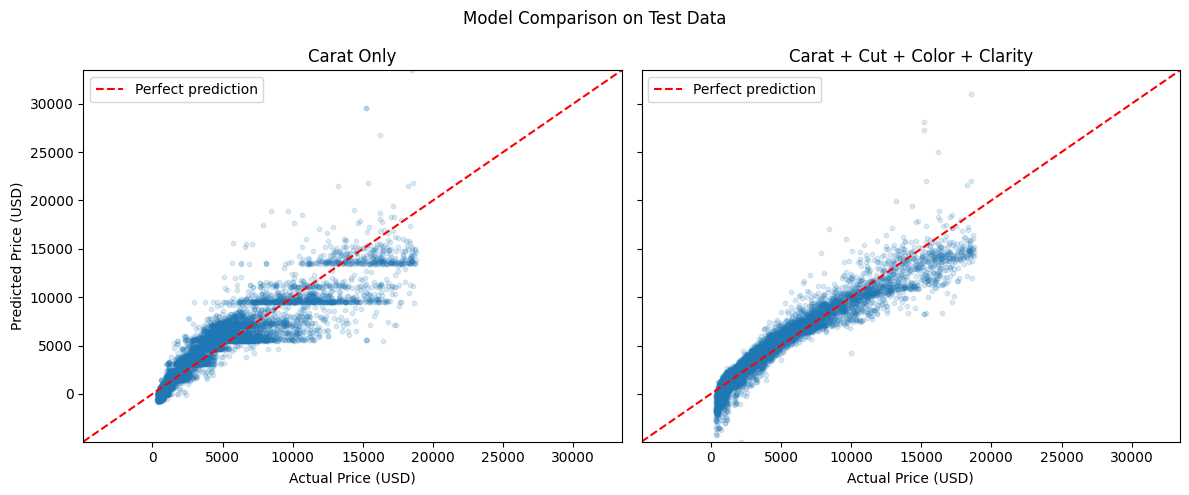
Adding quality attributes reduces test MAE by approximately 24.5%, calculated as (1,154.76 − 872.09) / 1,154.76. This is a reduction in prediction error, not an increase in margin or revenue.
Original notebook chart · Both models evaluated on the same test diamonds.
The business recommendation
Use carat as the starting point, not the whole price.
Include cut, color, and clarity in pricing estimates. Review unusual stones individually and compare estimates with current market evidence, costs, and target margins before choosing selling prices.
The demonstrated result is lower held-out prediction error. Commercial pricing impact was not measured.
What I would improve
A useful benchmark needs market context.
The linear relationship does not fully capture the observed price pattern; residual errors vary across fitted prices.
The dataset is not a current inventory or live market feed. Do not treat its fitted values as current quotations.
Statistical significance and strong correlation do not establish causality or guarantee accurate individual prices.
Next steps would test nonlinear specifications and validate on fresh inventory, with careful treatment of unusual observations.
The business narrative comes from the supplied presentation; model setup and results were cross-checked against the supplied notebook and its saved outputs. Presentation downloads are optimized visual copies. Original data files are required to rerun the analyses.
Data: Seaborn diamonds. Full-data descriptive R² is approximately .849; the PDF shows .8492 and the saved Python output .8493. The held-out comparison uses deduplicated modeling combinations and categorical OLS terms for cut, color, and clarity.